Digital vs offset printing for boxes: where the line crosses
Digital printing puts your artwork straight onto the board with no plates, so it is the right choice for runs of a few hundred boxes and for versions. Offset uses four plates and a make-ready, costs more to start and less per sheet after, and gives true Pantone spot colors. The line crosses around 500 sheets for most cartons.
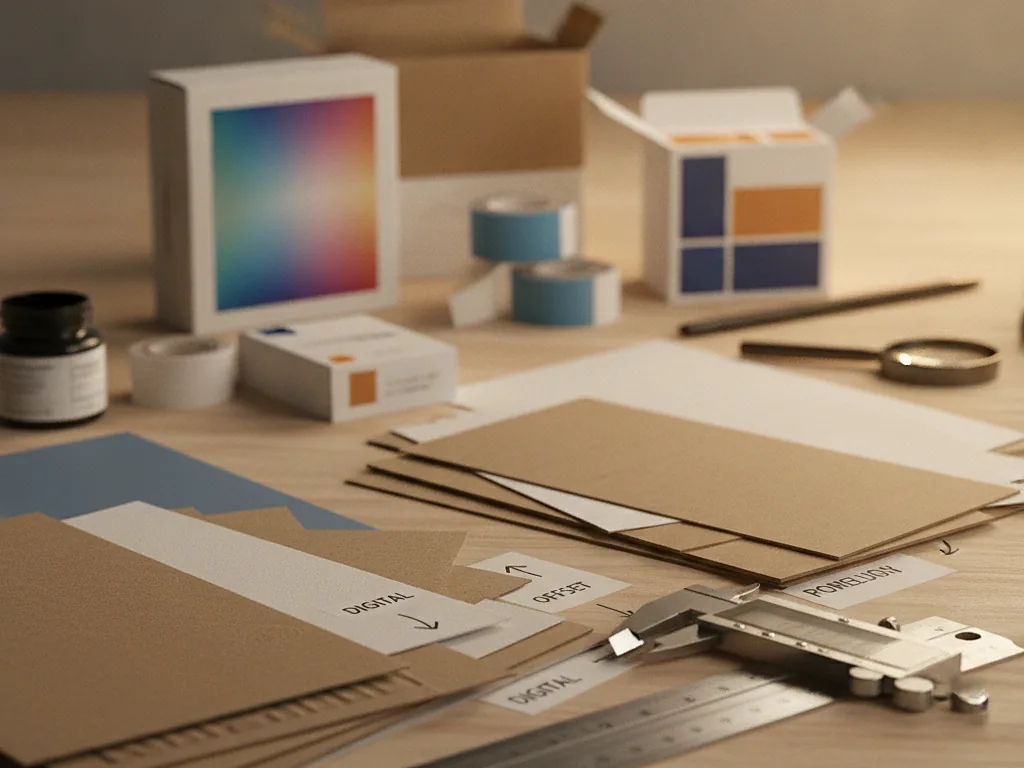
How each one works
Offset is the traditional press. Your artwork is separated into cyan, magenta, yellow and black, each burned onto an aluminum plate. Ink goes from plate to blanket to board, one color per unit, and the press is run up over a few dozen waste sheets until the color is right. Spot colors, metallics and a fifth or sixth ink are just another plate and another unit. Once it is running, the press puts out thousands of identical sheets an hour and the per-sheet cost is mostly ink and board.
Digital has no plates. The sheet goes through a press that lays down CMYK from a file, either dry toner fused with heat or liquid ink, and the first sheet is as good as the last. There is no make-ready and no waste, which is why 200 boxes make sense on it. Each sheet costs about the same as the one before, so the curve never bends downward the way offset does.
Side by side
| Digital | Offset | |
|---|---|---|
| Plates | None | One per color |
| Set-up waste | A few sheets | Dozens of sheets |
| Best quantity | 200 to about 500 sheets | 500 sheets and up |
| Spot colors | Matched from CMYK | True Pantone ink |
| Metallic ink | No, use foil | Yes |
| Versions | No plate cost per version; ask how versions count toward the minimum | New plates per version |
| Reprint match | Very close | Very close |
Color, and where digital falls short
Digital CMYK covers most brand colors well. Where it struggles is the far corners of the Pantone book: bright oranges, some deep blues, a true fluorescent, and any metallic. On digital those come out close and slightly duller, and we tell you on the proof which color is at risk. If the color is the brand, offset with a spot ink is the honest answer even at 250 units, and the plate cost is worth it. Large flat solids are the other place: a full-panel black or navy on digital can show faint banding under low, angled light, where offset lays it down as a single film of ink.
Offset has its own tell. Very fine gradients can show a rosette pattern from the halftone screen, while digital renders them smoother. Photography and skin tones tend to look better on digital at small runs. Neither is better in the abstract; each is better at something, and the right question is not which press is better but which one your artwork and your quantity want. Send us the file and we will answer that on the quote rather than in general.
An illustrative spec: where one carton crosses over
Illustrative spec, not a client order.
Take a straight tuck end carton at 2.25 by 2.25 by 5 inches on 18pt SBS. It lays out at about 9.5 by 11 inches flat, which gives 8 up on a 28 by 40 inch sheet after gripper and bleed. At 250 cartons, that is 32 sheets, and on digital those 32 sheets print in an hour with no plates and no waste. The same job at 2,000 cartons is 250 sheets, and offset runs those in less time than digital and at a lower cost per sheet even after the four plates are paid for.
The crossover for that carton sits close to 500 units, or about 60 sheets. Below that, digital is the default. Above it we quote both and tell you which we would choose. A carton with a Pantone orange as its main color would go offset even at 250. A carton with four artwork versions at 500 each would stay digital at 2,000, because four sets of offset plates would eat the saving.
What finishes and boards each one takes
Both take soft-touch, matte and gloss lamination, foil, deboss and spot UV after printing, and both run on our 18pt and 24pt SBS and natural kraft carton boards. Digital toner sits on top of the board, so a heavy solid on digital needs a laminate or an aqueous coating to protect it from scuffing; offset ink soaks in slightly and is tougher uncoated. Digital presses are limited on sheet size, usually to about 20 by 29 inches, so a very large carton or a mailer blank over that size goes to offset or to flexo regardless of quantity. Corrugated mailers are a separate case: one color flexo on a kraft mailer box for simple logos, digital on a white top liner for a full color printed mailer.
White ink is the one finish where digital has an edge at short runs. A white underprint on kraft or on a colored board is a fifth station and a plate on offset, and on digital it goes down in the same pass. So a kraft carton with a white logo at 200 units goes digital, and the same carton at 3,000 goes offset with a white plate, and the two look close enough to sit side by side on a shelf.
Questions people ask
Will a digital reprint match my first run?
Very closely. Digital printing is color-managed to a profile, and the same file printed six months later on the same board comes out within a tolerance that is hard to see. Reprints are checked against your approved proof before they ship.
Can I mix digital and offset across my range?
Yes. A common split is the hero carton at 2,000 on offset with a spot color and the seasonal versions at a few hundred each on digital. We match the digital to the offset sheet as closely as the gamut allows and tell you where it drifts. Both sit on the same board and take the same finishes.
Is digital lower quality than offset?
Not any more, for boxes. Ten years ago digital was visibly softer. Current digital printing on coated SBS gives sharp type at 5 point, smooth photography and solid color that is hard to tell from offset. The differences that remain are gamut and large solids, and we tell you on the proof if your artwork touches either.